
The World Bank on Tuesday raised India's growth forecast for the current fiscal to 6.5 per cent from 6.3 per cent estimated earlier, and said the country is expected to remain fastest-growing major economy, underpinned by continued strength in consumption growth.

S&P Global Ratings on Wednesday slashed India's GDP growth forecast for the current financial year to 9.8 per cent saying the second Covid wave may derail the budding recovery in the economy and credit conditions.
India Ratings and Research on Friday revised down India's FY22 real GDP growth forecast to 10.1 per cent, from earlier projection of 10.4 per cent, citing the second wave of COVID-19 infections and slower pace of vaccination. At a time when large parts of the country are experiencing tremendous pressure on medical infrastructure, the agency said it expects the second wave to start subsiding by mid-May. Earlier this month, the Reserve Bank maintained its 10.5 per cent GDP growth estimate, but Governor Shaktikanta Das has flagged the rising cases as the biggest impediment to recovery.

It said that the GDP growth has averaged 7.3 per cent from 2014-15 to 2017-18, which is the highest among the major economies of the world.

The Reserve Bank of India (RBI) on Friday delivered a 25 basis point (bps) repo rate cut analysts expected, driven by the strong 8.2 per cent GDP growth in the September quarter. However, analysts do not expect a runaway market rally as the impact of US tariffs continues.

Enthused by the estimated 8.1 per cent growth in 2003-04, Planning Commission on Friday said the targeted 8 per cent annual growth during the Tenth Plan period was now within the realms of possibility.

India has expressed serious concerns about the West Asia crisis and its potential impact on energy supplies and maritime stability, urging BRICS nations to find practical solutions to geopolitical challenges and unilateral sanctions.

NCAER said the monetary policy measures are unlikely to revive growth at this juncture and suggested providing fiscal stimulus, which too can be challenging unless it can be financed through better revenue generation.

'Even if the war ends tomorrow, which is unlikely, and we go back to the pre-war status quo, the world will still need some time to get over the sudden shock of oil price increases.'

A ramp-up in COVID-19 vaccination, healthy advance estimates of kharif (summer) crop and faster government spending were the factors which led to the revision, the agency said in a statement. It can be noted that after the 7.3 per cent contraction in 2020-21, there were expectations of a higher growth number in 2021-22.

Earlier, the CSO in its advance estimate had pegged the GDP growth rate for 2018-19 at 7.2 per cent.
GDP growth for the current year is expected to be about 8.5 per cent while inflation likely to be below five per cent, Reserve Bank of India Governor Y V Reddy said in Chennai on Friday. "For the current year, though subject to review, current expectations is GDP growth will be 8.5 per cent.Inflation would be below five percent," he said at a management seminar conducted by the Great Lakes Institute of Management.
Voicing concerns on overheating, Crisil Ratings on Monday said rising interest rates and liquidity constraints would push down India's GDP growth in the range of 7.9-8.4 per cent in 2007-08.

The Indian economy is likely to witness close to double-digit growth in the current fiscal year despite the second COVID-19 wave ravaging the country, Principal Economic Adviser (PEA) Sanjeev Sanyal said on Wednesday. The economy is slowly getting back to normalcy as the number of COVID-19 cases is declining, he said while participating in India Global Forum event. "We are probably going to see close to double-digit, if not double-digit (growth) in this financial year," he said.

'Once the market decides it wants to go up, it goes up -- no amount of bad news can really hold it back.'

'The outlook for the next Samvat is more constructive, as many of the earlier drags are gradually becoming supports.'

India's household debt climbed to 41.3 per cent of gross domestic product (GDP) at the end of March 2025, marking a sustained rise from its five-year average of 38.3 per cent, with consumption-related loans accounting for bulk of the borrowings, the Reserve Bank of India (RBI) said in its Financial Stability Report.
Poor rainfall in rain-dependent central and southern India in the next three weeks could affect agricultural GDP growth in the coming season, a report by broking firm Motilal Oswal has said.
Credit Suisse First Boston, a leading investment banker, has scaled down India's GDP growth from 5.7 per cent to 5.4 per cent for the financial year 2002-03.\n\n\n\n
The overall gross domestic product growth for 2004-05 is expected to be 6-6.5 per cent, taking into account risks of high and uncertain oil prices and changes in international liquidity environment, says RBI's report on currency and finance 2003-04.
For the economy to grow by 6.9 per cent in 2011-12, GDP growth for the fourth quarter needs to be 6.9 per cent.

India's GST revenues experienced significant growth in March, reaching pre-tax cut levels, driven by increased imports and domestic sales. The report analyses the impact of tax rate changes and provides insights into future trends and economic stability.

The benchmark BSE Sensex's trailing 12-month price-to-earnings (P/E) multiple has declined to 20.2x, its lowest since May 2020, driven by a record $42 billion FPI selloff since September 2024 and concerns over corporate earnings and economic growth.

'...especially pressure on the rupee, the current account deficit, and foreign exchange outflows.' 'The key question over the next several months is whether the government can prevent external turbulence from feeding into domestic economic pessimism.'
Foreign investment firm Credit Suisse First Boston said on Thursday that delayed monsoon is unlikely to have a "significant impact" on India's economic growth pegged at 5.7 per cent in 2004-05.
The Indian economy is expected to grow around 10 per cent during the current financial year on the likelihood of fewer COVID-19-linked supply disruptions and buoyancy in the global economy, said Poonam Gupta, director general of economic think-tank NCAER. The real challenge, however, would be to sustain a growth rate of 7-8 per cent in years to come, she said. "We could see annual growth in the ballpark range of about 10 per cent. "The reasons for this perceived optimism are: fewer supply disruptions; increased pent-up demand in the traditional and contact-intensive services; and a buoyant global economy.

The Indian banking sector could be due for a rise in profitability after several quarters of net interest margin (NIM) compression. The Q2FY26 results suggest NIMs have bottomed out.

While participants in the domestic financial market are expecting a 25 basis-point policy repo rate cut in the December meeting of the Monetary Policy Committee (MPC) of the Reserve Bank of India (RBI), economists remain torn between a reduction in rate cut and a pause.

A look at six indicators shows all of them have collapsed from positive growth in April to contraction in September.

Optimism comes at a time when several agencies trimmed forecast to as low as 5.5% citing inaction policy paralysis as major growth impediment
Niti Aayog CEO Amitabh Kant said only farm revolution can make it possible. He also stressed on scrapping Agriculture Produce Marketing Committee and some old laws like Essential Commodites Act, which restrict movement of farm produces.

The conflict may disrupt Budget 2026-2027 projections, squeezing revenues and raising subsidies, prompting fiscal adjustments and potential reforms, echoing lessons from the Covid-era shock, points out A K Bhattacharya.
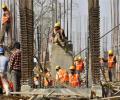
The First Advance Estimates of National Income, 2016-17 did not reflect the impact of demonetisation, effected on November 9 and are based on sectoral data for only seven months to October.

India Inc on Friday expressed the hope that the robust 17.6-per cent industrial growth in April will help the economy grow by 8.5 per cent in this fiscal, even though factory output growth may moderate after June.

The Indian rupee crashed to a record closing low against the US dollar due to rising global crude oil prices, a strengthening dollar, and geopolitical tensions in the Middle East.

India ranked 116th out of 147 countries in 2025 with an average score of 4.536.

RBI Governor Shaktikanta Das said that early containment of the pandemic could impart an "upside" to the economic growth outlook.

The Centre for Monitoring Indian Economy (CMIE) has revised its GDP growth forecast for the current fiscal to 6.2 per cent from six per cent announced last month.

Foreign portfolio investors (FPIs) infused Rs 22,615 crore into Indian equities in February, marking the highest monthly inflow in 17 months, driven by factors such as the interim India-US trade deal, correction in domestic market valuations, and strong corporate earnings.
A Reserve Bank-authorised survey on Monday lowered the country's economic growth rate projection to 5.7 per cent for the current fiscal, down from 6 per cent estimated earlier.
